Personal Intelligence

The hardest part of reading more is not always finding the time. Sometimes it is deciding what kind of reader you are trying to become.
Lately, I have been falling behind on my reading goals. I have always been a reader; in the past, I would read twenty or thirty books a year. One of my resolutions for 2026 was to read more, but as I became more judicious with my time, a different question started to loom: what should I read next? I want to read interesting books that go beyond the popularity bubbles, and expand my horizon. Essentially driven by what someone building an intellectual life should read. I felt the need for a personal literary curator, someone akin to a Royal librarian responsible for the education of young princes. Someone who has read deeply, who isn’t trying to sell me a bestseller.
I have friends whose taste I trust and who have a good idea of what I would enjoy reading. But the throughput is quite low, a handful of suggestions a year, and only on what they themselves have read. Also, as my taste is evolving, it is unfair to put this onus on friends (they are already doing enough) while I myself struggle to articulate my taste at any point. I love nagging booksellers for their recommendations which is great for discovery at times. But more often the suggestions reflect their taste rather than mine and the throughput is low. Social media has been a great source of inspiration for me, particularly in niche hobbies and topics. But the circles like Bookstagram, BookTok, the literary corner of X, and online book clubs fall short when it comes to going beyond popularity. Even though one can argue social media has real opinions from real readers, but visibility on those platforms is driven by reach. What surfaces is whatever is already popular within whatever bubble you happen to be standing in. The discovery tail is short. Further, these circles tend to brew and follow trends, for example my feed was full of International Booker Longlist in the past couple of months. And I am noticing a popularity surge for East of Eden.
At the surface this reads like a recommendation system problem. However, most algorithmic recommender systems optimise for something I am not asking. Given what you have already liked, here is more like it. Whatever I enjoy comes back, recombined, infinite. It is a perfect way to never read anything that surprises me again. This isn’t really about algorithmic recommenders being broken. Recommendation engines are population systems. They learn patterns from a large pool of users, optimize for the median reader, and answer what someone like me would enjoy reading rather than what I would enjoy reading. The result tends toward the bestseller, the second book by the author you already like, the next genre adjacency. Even when they personalize, they do it by locating you on a manifold of other users. They are not designed to care about the shape of my intellectual life. They personalize toward preference rather than growth.
More of what you like is the wrong goal. What you should read next is the right one.
By “should,” I do not mean a universal canon or a moral duty. The librarian I wanted is closer to a teacher, or an interesting friend who refuses to flatter me. Someone who has read more than I have, who notices my taste and its edges, and is willing to push past them. What I am describing is a personal intelligence system which is fundamentally different from a population intelligence system.
A personal intelligence system is organized around one person’s evolving context rather than a population’s aggregated behavior. It has memory, legibility, and an ongoing model of change.
A population system attempts to learn what am I and use that to determine what I would like. A personal system tackles a different question — what am I becoming and use that to determine how to mediate my journey. Population systems classify. Personal systems accompany. As you interact with a personal system, it attends to what is changing, what is recurring, what is emerging, and what is being left behind to build an understanding of your taste and its trajectory. This journey is the first-class citizen and the role of the system is to be a companion through this process whose direction isn’t determined in advance.
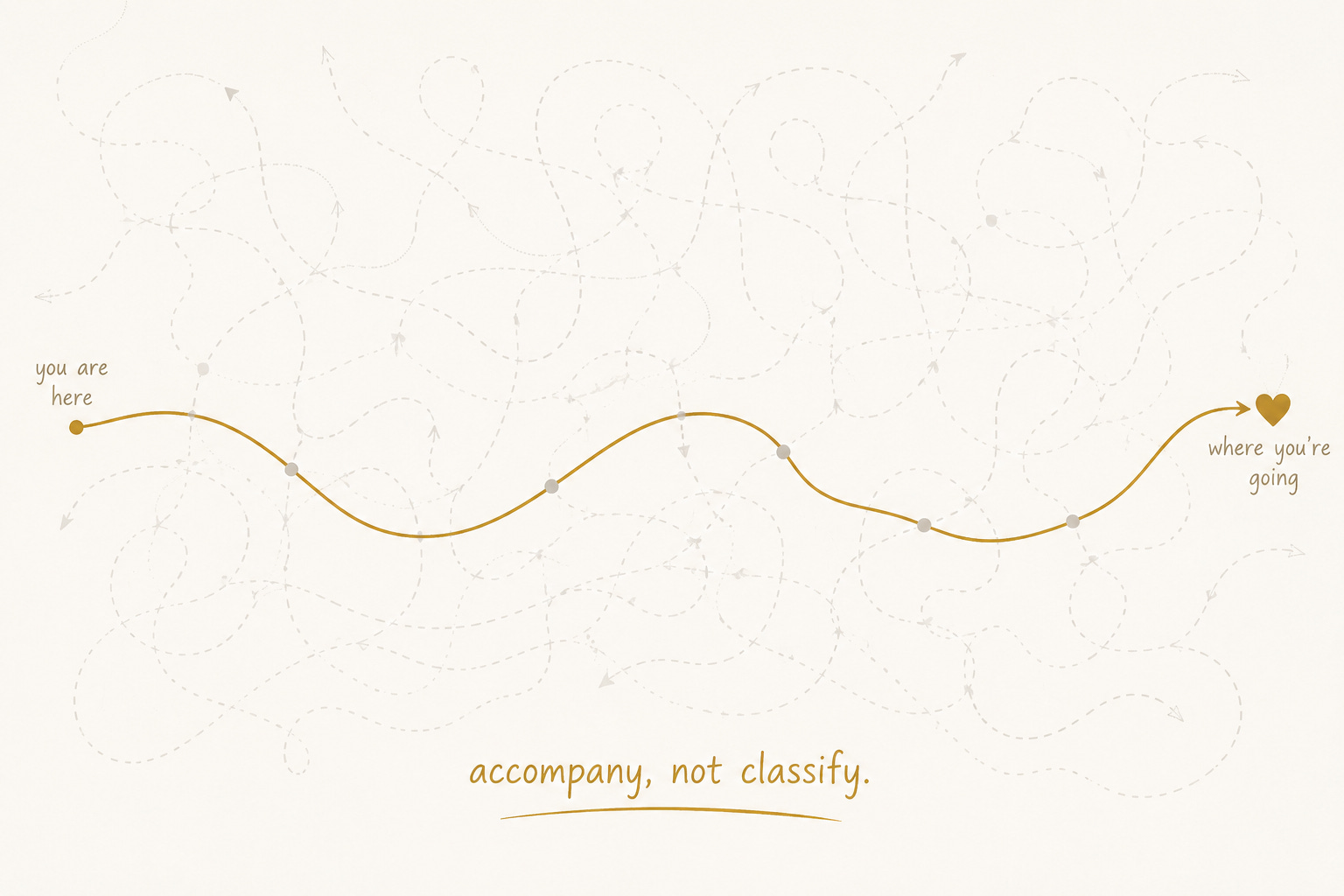
With this goal, I built a personal literary curator for myself called Marginalia. It suggests books for me based on a feeling, theme, topic, or mood and its knowledge of me, my reading taste, and how my reading is evolving. It is primed to go beyond what algorithmic recommenders or social media bubbles normally surface.
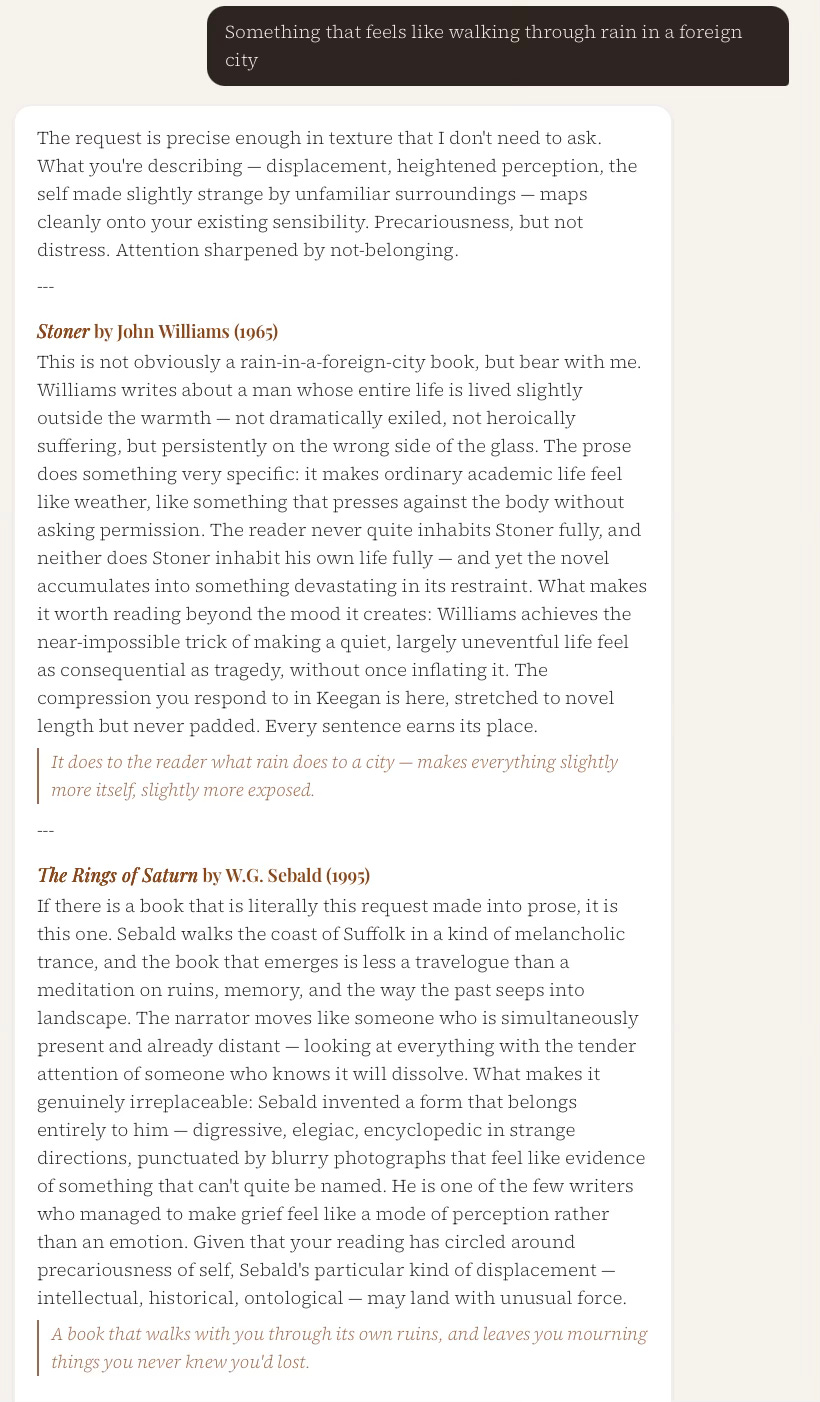
It has four temperaments I can switch between: The Sage, The Bookseller, The Provocateur, The Companion, each producing meaningfully different recommendations from the same data. Marginalia is a Rorschach blot: the same request, read by four personas, returns four different books. The system doesn’t have to guess whether I am in exploration or exploitation mode. I tell it, by choosing a persona. In a population system, the choice between novelty and familiarity is made for me, latently, optimised against population-level objectives. In a personal system, the choice is mine to declare, and visible to me when I make it.
Marginalia tracks the books it suggests through their whole life (suggested → purchased → reading → read or abandoned), holds my notes, my ratings, the passages I copy from what I am reading, and quietly builds a taste portrait of me as a reader. That portrait gets fed back into every future recommendation, so the system gets more accurate the more I use it. The system is designed to update the taste profile as I use and highlight its evolution to me. It is a strange and slightly invasive pleasure to have something accurately describe your reading taste back to you. I don’t think I could articulate my taste so lucidly. Seeing my image develop in front of me is like looking into Yata no Kagami, the mirror that returns the self truthfully. There is an empathy in this invasiveness, the system tells me what it believes my reading taste to be, which informs its reasoning.
Traditional population system can’t show the evolution of taste as they might not have right tool and vocabulary. I don’t know what I was into 12 months ago on Twitter or Instagram. Marginalia tracks the shape of my reading, and the shape changes, and that change is the subject rather than a covariate. A population system can register that I have moved to a new region of taste-space. Only a personal system can take seriously the idea that me becoming someone, and that the becoming itself is what should be cared for.
In population systems, there is no obvious machinery that can nudge the system to change my taste or tell it what I aspire to become. In the past, I have spent hours altering my Twitter timeline by searching and engaging with the content I want to see, only for it to go back to popular and viral in a few days. With a personal system like Marginalia, I get to know who I am and who I am becoming, can intervene, and the system can also push back resulting in a more engaging and intimate experience.
The most useful conversations were the ones where the librarian had been a little forward.
“You’ve started three books and finished only one this past month. Are you in a reading rut, or is something else competing for your attention?”
I sat with it for a minute before answering. The question was correct. It was also the kind of thing a real friend who read alongside me might ask. This is what personal intelligence feels like.
Marginalia is a personal intelligence system. There is one user, one library, one history, one developing taste. The system is not trying to predict what people like me would enjoy; it is trying to know me well enough to be a useful companion in the particular project of being me. It doesn’t know about any other person, except what it learned during LLM training.
Personal intelligence systems were uneconomic for most of the intelligent software development history. They required more human capital, storage, and compute. This pushed everything toward population systems. Further, the nature of the learning algorithms required data from a large number of users over a sufficient time period to draw patterns. And they need to be re-trained or continually trained to pick drifts in the population behaviour. The traditional learning systems are inefficient to allow us to build personal systems.
A personal system for each user requires a foundational general layer on which specifics can be attached. With the recent improvements in LLMs, we are building general-purpose reasoning engines. This opens a plethora of opportunities for personal intelligence system as my specifics (books read, passages saved, notes written, books abandoned) can sit on top of that general layer as context.
In a recent interaction, Marginalia offered:
“You’ve been saving passages about desire that never quite arrives at its object — is that something the books are helping you sit with, or something you’re trying to understand?”
This is what a personal intelligence system can do something that the system driven by population metrics are not capable of. This is the kind of software I find myself wanting: not software that predicts the next click, but software that helps me remain in conversation with the person I am becoming. The deeper experiment is not about books. It is about whether software can learn to accompany a life without reducing it to a profile.
Please cite this post as:
@article{verma2026personal-intelligence,
  title={Personal Intelligence
  year={2026},
  url={\url{https://januverma.substack.com/p/personal-intelligence}},
  note={Incomplete Distillation}
}
Great post. I would love to meet anyone thinking about similar ideas!